In many businesses, display systems were once considered a secondary item, simply needed for presentations. However, as organizations expand, data grows, and work models change, the role of displays in businesses also shifts. Meeting rooms, conference halls, and executive centers are no longer simply places to project slides, but have become spaces for information exchange, data analysis, and decision-making.
In this context, LED display solutions for businesses should not be understood as simply installing a display device, but rather as part of a central display system serving long-term operations and management. Currently, many businesses are beginning to approach display solutions from a more holistic perspective; further information can be found at Luxmage – a provider of enterprise display solutions.
.png)
Projectors and video walls were once popular choices due to their low initial investment costs and ease of deployment. However, in today's business environment, these solutions are gradually revealing many limitations.
Projectors perform poorly in brightly lit spaces. When lights are on for note-taking or moving around, the image is often blurry, and contrast is noticeably reduced. With video walls, even though they can create large sizes, the borders between the panels divide the content, especially when displaying charts, data, or full-screen videos.
Furthermore, in large spaces with a high number of attendees, ensuring that everyone can clearly see the content is a challenge. Uneven display makes it difficult for those sitting far away to follow, reducing the effectiveness of the meeting and information exchange.
.png)
Not every business needs to invest in LED screens. However, in the following scenarios, LEDs often deliver noticeable results:
In these situations, LED screens help ensure that content is displayed clearly, seamlessly, and consistently for all attendees, regardless of seating position or lighting conditions.
A common mistake when investing in LED displays is focusing solely on the size or specifications of the device. In reality, LEDs are only effective when integrated into an overall enterprise display system.
A complete LED display solution includes not only the display screen, but also integrates with other layers in the system:
This approach also aligns with the trend of building digital meeting room systems as a central display platform in enterprise digital transformation, as analyzed in detail at: Digital Meeting Room Systems: A Display Platform in the Enterprise Digital Transformation Roadmap.
When the components are designed to be integrated, the meeting room or display space will operate smoothly and be easy to use, even for non-experts.
.png)
Approaching LED displays with a systems mindset helps businesses avoid fragmented investments and redundant configurations. Instead of choosing the "most powerful" device, businesses can select a solution that suits their actual needs while ensuring scalability and long-term usability.
This is also a way to optimize investment costs, avoiding situations where equipment quickly becomes outdated or unsuitable when usage needs change.
The display layer is the most visually apparent part of the system. Choosing an LED screen requires considering many factors, not just size.
The size and layout of the space determine the appropriate screen size. Viewer distance directly affects the required resolution. In many cases, a high "theoretical" resolution may not necessarily be effective in practice if it is not suitable for the viewing distance.
An effective display solution is one that allows everyone in the room, whether sitting close or far away, to clearly see the content.
In a business environment, two common LED technologies often considered are SMD LEDs and COB LEDs.
The choice between SMD and COB should be based on actual usage needs and budget, rather than chasing the latest technology.
The control layer acts as the "behind-the-scenes" engine of the system. This component manages the connection of laptops, video conferencing equipment, cameras, and other content sources.
A well-designed control system allows users to easily operate, quickly switch content, and minimize interruptions during meetings. This is especially important for executive meetings or online conferences, where technical disruptions can affect workflow.
.png)
For frequently used meeting rooms with a large number of attendees, LED screens ensure clear content display in all lighting conditions. However, for small meeting rooms or infrequent use, businesses may not need to invest in LED screens.
In practice, many businesses choose LED meeting room screens designed with a systems mindset, ensuring clear display, stable operation, and suitability for frequent use: LED Meeting Room Screens – When Should You Replace Projectors & Video Walls?
Accurately assessing needs helps in selecting the right solution and avoiding wasted budget.
.png)
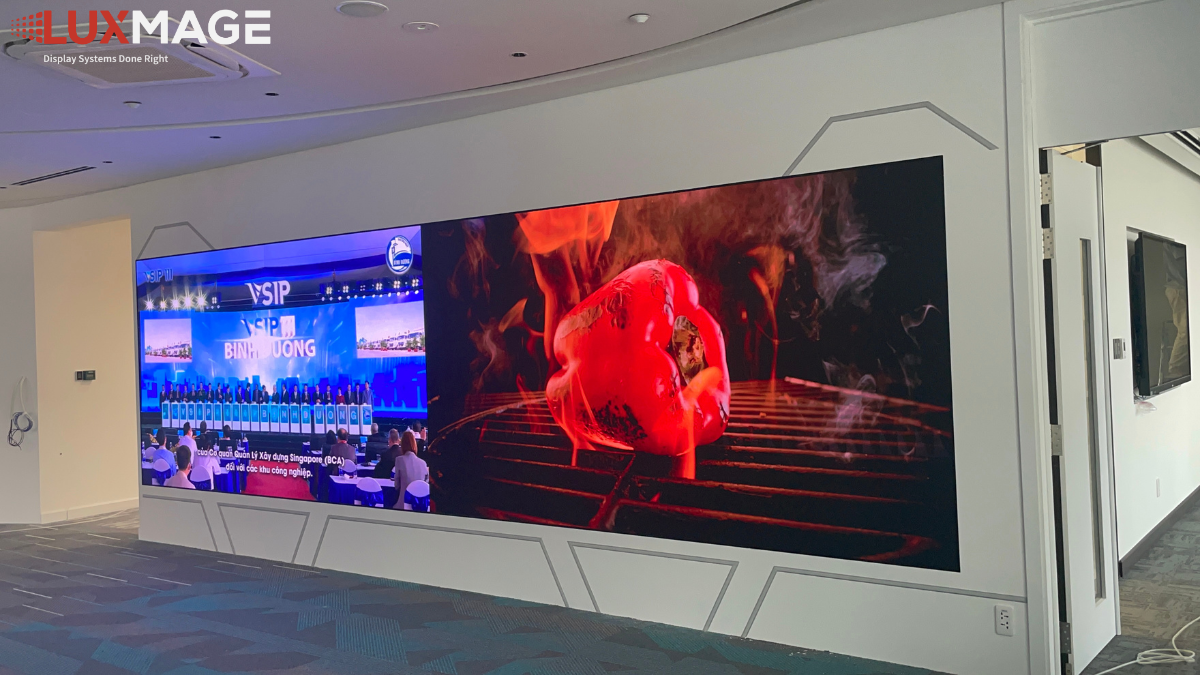
In conferences and large auditoriums, uniform display across the entire space is crucial. Compared to projectors, LED screens offer more stable images, are not dependent on ambient light, and do not suffer from content fragmentation.
Operations centers often require real-time data display and continuous operation. In this scenario, LED screens act as the central display layer, ensuring that data is presented clearly and stably over extended periods.
For businesses with multiple meeting rooms or branches, standardizing display solutions helps ensure a consistent experience and simplifies management and operations.
Instead of redesigning each space from scratch, businesses can deploy a solution framework that works for everyone, simply adjusting the configuration to suit their needs.
.png)
LED screens offer high flexibility in size and configuration, allowing for easy adaptation to individual spaces without altering the overall system architecture. Thanks to their modular scalability, LEDs can be deployed synchronously across multiple meeting rooms or display points, while maintaining a consistent user experience.
Furthermore, the high stability and ability to operate continuously for extended periods make LED displays particularly suitable for standardized enterprise display system strategies. Instead of investing separately in each space, businesses can use LEDs as a central display layer that is easy to manage, easy to maintain, and readily expandable as usage needs change in the future.
LED display solutions for businesses shouldn't start with equipment selection, but rather with actual usage needs. When designed with a systems mindset, LED displays become a central display platform, contributing to improved operational efficiency, decision-making, and supporting businesses in their long-term development.
To choose a solution that suits the space and intended use, businesses should conduct thorough surveys and consultations from the outset. For more detailed discussions about implementation options, businesses can contact our consulting team directly here .
Contact us at:
Luxage Technology Co., Ltd.
Address: 63 Lo Lu Street, Truong Thanh Ward, Thu Duc District, Ho Chi Minh City
Hotline: 0988.895.066 - 093.333.5066
Email: sale@luxmage.com
Hot news
Project Reference

Posted by: Admin - Date: 27-01-2026


